
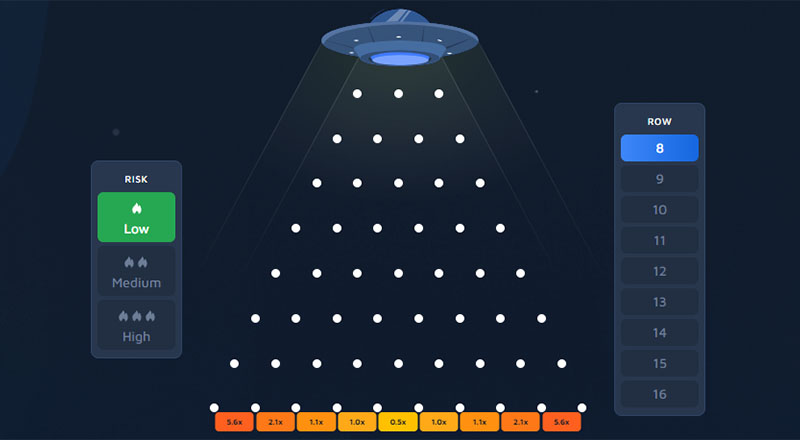
Plinko looks like a toy. A ball falls through a triangle of pegs, bounces around, and lands in a slot with a multiplier on it. That is the whole game. No paylines, no bonus rounds, no opponents. You bet, you drop, you get a number back in about a second.
That simplicity is exactly why the Crypto Plinko Game became one of the defining titles of the modern crypto casino. But «simple to play» is not the same as «simple underneath.» There is real probability theory in the board, and real cryptography in how the result gets generated. If you understand both, you stop guessing and start seeing the game for what it is: a clean, verifiable bet on a bell curve.
This is a technical look at how Crypto Plinko works, with the actual formulas, not vibes.
What the board is doing
When you load Plinko at a crypto casino, you pick three things before you drop: the cryptocurrency you are betting (Bitcoin, ETH, or a stablecoin like USDT), the number of peg rows, and a risk level of low, medium, or high. Then the ball falls.
Every time the ball hits a peg, it goes left or right. On a fair board that is a 50/50 coin flip, and each flip is independent of the last one. A board with 16 frows means the ball makes 16 of those flips before it lands. The slot it ends up in is decided entirely by how many times it went right versus left.
That is the part most players never think about. The ball is not «finding» a slot. It is running a sequence of coin flips, and the slot is just the tally.
The distribution that runs everything
Sixteen independent left/right decisions with 17 possible landing slots. The number of distinct paths that lead to each slot follows the binomial distribution, which you can read straight off Pascal’s Triangle.
The probability of landing in slot k after N rows is:
P(k) = C(N, k) / 2^N
where C(N, k) is the binomial coefficient (the count of paths to that slot) and 2^N is the total number of paths. For a 16-row board that denominator is 65,536. This is not an approximation of the game. It is the game.
Here is what that means in practice for the most common row counts:
| Rows | Total paths | Center slot odds | Each far-edge slot |
| 8 | 256 | ~27.3% | ~0.39% (1 in 256) |
| 12 | 4,096 | ~22.6% | ~0.024% (1 in 4,096) |
| 16 | 65,536 | ~19.6% | ~0.0015% (1 in 65,536) |
Notice what happens as you add rows. The center stays the most likely spot, but its share shrinks and the edges get brutally rare. On a 16-row board, hitting one specific corner is a 1-in-65,536 event. Hitting either corner is 1 in 32,768. The freeslots99 odds breakdown and the gamblingcalc Plinko calculator both land on the same numbers, because there is only one correct answer here.
This is also why the edges carry those eye-watering multipliers. A crypto casino plinko board that pays 1000x on a 16-row high-risk corner has to pay that much, because the event is so rare that anything smaller would push the math out of balance. The payout has to be inversely proportional to how often the slot gets hit, or the whole return model breaks.
House edge and RTP, no spin
Here is the honest part most guides skip. None of your settings change the long-run return.
Across the major game providers, Plinko runs at roughly a 1% house edge, which is a 99% RTP. BGaming publishes a 99% rate, and Stake-style implementations sit at about 99% across every row and risk combination. Some operators in the wider market run lower, and you will see RTP figures anywhere from about 94% to 99% depending on the provider, so the in-game info panel is the only number that matters for the table you are actually playing.
The edge is baked into the multipliers, not the physics. You can prove it to yourself. Take every slot’s multiplier, multiply it by that slot’s binomial probability, and add them all up. For a 16-row medium board the sum comes out to about 0.99. That 0.99 is the RTP. There is no hidden mechanism. The casino’s cut is sitting in plain sight inside the payout table, and you can audit it with a calculator.
So when someone tells you they switch to high risk «after a cold streak because they’re due,» that is the gambler’s fallacy in a hat. Each drop is independent. A losing run does not load the next ball toward an edge. The math guarantees the average over the long haul, never the order things arrive in.
What rows and risk actually change
If they do not move the RTP, what are they for? Variance.
Rows control the shape of the curve. More rows means a taller, narrower peak in the center and fatter, rarer tails at the edges. Twenty-six row boards are not «better odds,» they are a different volatility profile.
Risk level redraws the multiplier map on top of that curve. Low risk keeps most slots near 1x, so you grind small, frequent results and your bankroll bleeds slowly. High risk strips value out of the common center slots and piles it onto the rare edges, so most drops lose a little and the occasional one pays a lot. Both settings have the same expected return. They just feel completely different to play. Low risk is the one to pick if you are chasing a long session or clearing wagering requirements. High risk is for people who want the 1000x lottery and accept that it almost never comes.
Provably fair: the cryptography behind the drop
This is where Crypto Plinko earns the «crypto» half of its name, and it is the real reason the genre took off.
On a regular online slot you cannot see how the result was made. You trust the operator and that is it. Provably fair flips that around using a commit-reveal scheme that you can check yourself.
Three values produce every outcome:
• Server seed — a secret random string the casino generates. Before you play, the casino shows you only its SHA-256 hash, a 64-character fingerprint. Because SHA-256 is a one-way function, that hash proves the seed exists and is locked, without revealing it. The casino cannot change the seed afterward, because any change would produce a different hash than the one you already hold.
• Client seed — a random string from your side, either auto-generated on your device or one you set. The casino does not control it, which means it cannot cherry-pick a server seed that combines with yours for a bad result.
• Nonce — a counter that starts at zero and ticks up by one with every bet. Same seeds, new nonce, fresh result. It guarantees each drop is unique even when the seeds stay fixed.
The outcome is computed with HMAC-SHA256, using the server seed as the key and the client seed plus nonce as the message:
result = HMAC-SHA256(server_seed, client_seed + «:» + nonce)
That produces a 64-character hex string. The game converts it into a number by reading the first several bytes as an integer and dividing down to a float between 0 and 1, then maps that float onto the board: either a left/right decision at each peg, or a direct slot index. Some operators use HMAC-SHA512 or a pre-generated hash chain instead, but the principle is identical across all of them: the result is pre-committed and deterministic. It is, as the StakeAnalyzer documentation puts it, the same cryptography that secures Bitcoin.
How to verify a round yourself
The whole point of provably fair is that you do not have to take anyone’s word for it. After you rotate your seeds, the casino reveals the raw server seed it used for your previous bets. From there:
1. Hash the revealed server seed with SHA-256 and confirm it matches the commitment hash you were shown before you played. If it matches, the seed was never swapped.
2. Take that server seed, your client seed, and the nonce of the bet you want to check.
3. Run them through HMAC-SHA256 using the casino’s published formula.
4. Convert the hash to a number and map it to a slot the same way the game does.
5. Confirm the slot matches what you saw on screen.
If everything lines up, the round was fair. Independent browser-based checkers from tools like Spindex and StakeSim run the same HMAC-SHA256 math locally, so your seeds never leave your machine. And one practical note from the casinosblockchain walkthrough: if your verification fails, you almost certainly copied a value wrong before you caught an actual scam. The cryptography itself is not the weak link.
This is the real test of any crypto casino plinko game. Can you see a hashed server seed before the round? Can you change your client seed? Is there a verifier for past bets? Is the RTP published? If the answer to most of those is no, the «provably fair» badge is decoration.
Why crypto and Plinko fit so well
Plinko has no rounds, no dealer, and no waiting. You drop and you settle, instantly. That tempo is awkward for traditional banking, where a deposit can take days, but it suits crypto perfectly. A stablecoin bet confirms fast, the result resolves in seconds, and you can fire off hundreds of drops in a session without a payment processor in the loop.
Stablecoins also fix the one thing that makes BTC betting annoying, which is price swings on tiny stakes. Betting in USDT means a 0.5x result is a 0.5x result, not a number that drifts because the coin moved while you were playing. Add the provably fair layer on top and you get a game that is fast, cheap to run, and auditable end to end. That combination is hard to build with fiat rails, and it is most of why the crypto Plinko game spread the way it did.
The honest bottom line
Plinko is a game of chance with a fixed mathematical edge, and no betting pattern, risk level, or row count gets around it. What you can control is variance and bankroll. Pick low risk and small stakes to stretch a session. Pick high risk if you genuinely want a shot at a rare big multiplier and you have decided in advance what you are willing to lose chasing it.
What makes the crypto version worth playing over a generic version is not the multipliers. It is that you can verify every single drop. The board is honest binomial math, the result is locked cryptography you can recompute, and the house edge is sitting right there in the payout table for anyone who cares to add it up. That transparency is the actual product. Treat the entertainment as the thing you are buying, set a budget you will not chase past, and the game does exactly what it says it does.